
How to Use Boolean In Search with Examples
Master Boolean search operators (AND, OR, NOT) with clear examples to refine academic and web research results.
In today's information-saturated world, search engines are our go-to tools for navigating the vast ocean of knowledge. Imagine you're a researcher seeking scholarly articles on the impact of climate change on coral reefs. A simple "climate change coral reefs" search might yield an overwhelming load of information, both relevant and irrelevant. This is where Boolean operators come in as our trusty filters.
What is Boolean search?
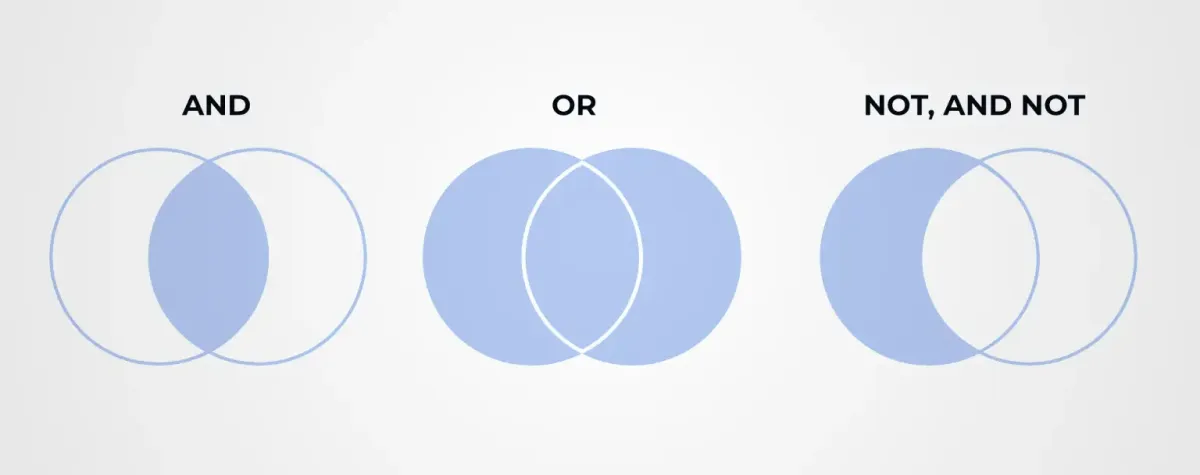
Boolean search is a powerful tool that enables users to refine their search results by using operators such as "AND," "OR," and "NOT." By combining these operators with specific search terms, individuals can narrow down or broaden their search, making it more effective and efficient.For example, using the "AND" operator allows users to find results that contain both of the specified search terms, while the "OR" operator helps to broaden the search by finding results that contain either of the search terms. On the other hand, the "NOT" operator allows users to exclude certain terms from their search results.Breakdown of Boolean search
To use Boolean search, you need to combine your search terms with the Boolean operators. Here’s how to use each of the three primary Boolean operators.The AND operator: The AND narrows down your search by requiring all specified terms to be present in the results. "Climate Change AND coral reefs AND bleaching" ensures you only encounter articles directly addressing the connection between climate change and coral bleaching.
The OR operator: The OR broadens your search by including results containing any of the specified terms. "Climate change OR global warming OR greenhouse gases AND coral reefs" encompasses articles discussing these related concepts within the context of coral reefs.
The NOT operator: The NOT excludes undesired terms. "Climate change AND coral reefs NOT tourism" eliminates articles primarily focused on the tourism industry's impact on coral reefs, allowing you to delve deeper into the specific ecological concerns.